

REMA Studies 2025

The 2025 edition of an annual survey conducted by REMA aimed to assess the impact of budget cuts on the activities of its members. When the results of the 2025 study were first received, the figures appeared alarming. Only a few months later, developments in the sector indicate that the situation may be even more serious, particularly for festivals and independent ensembles.
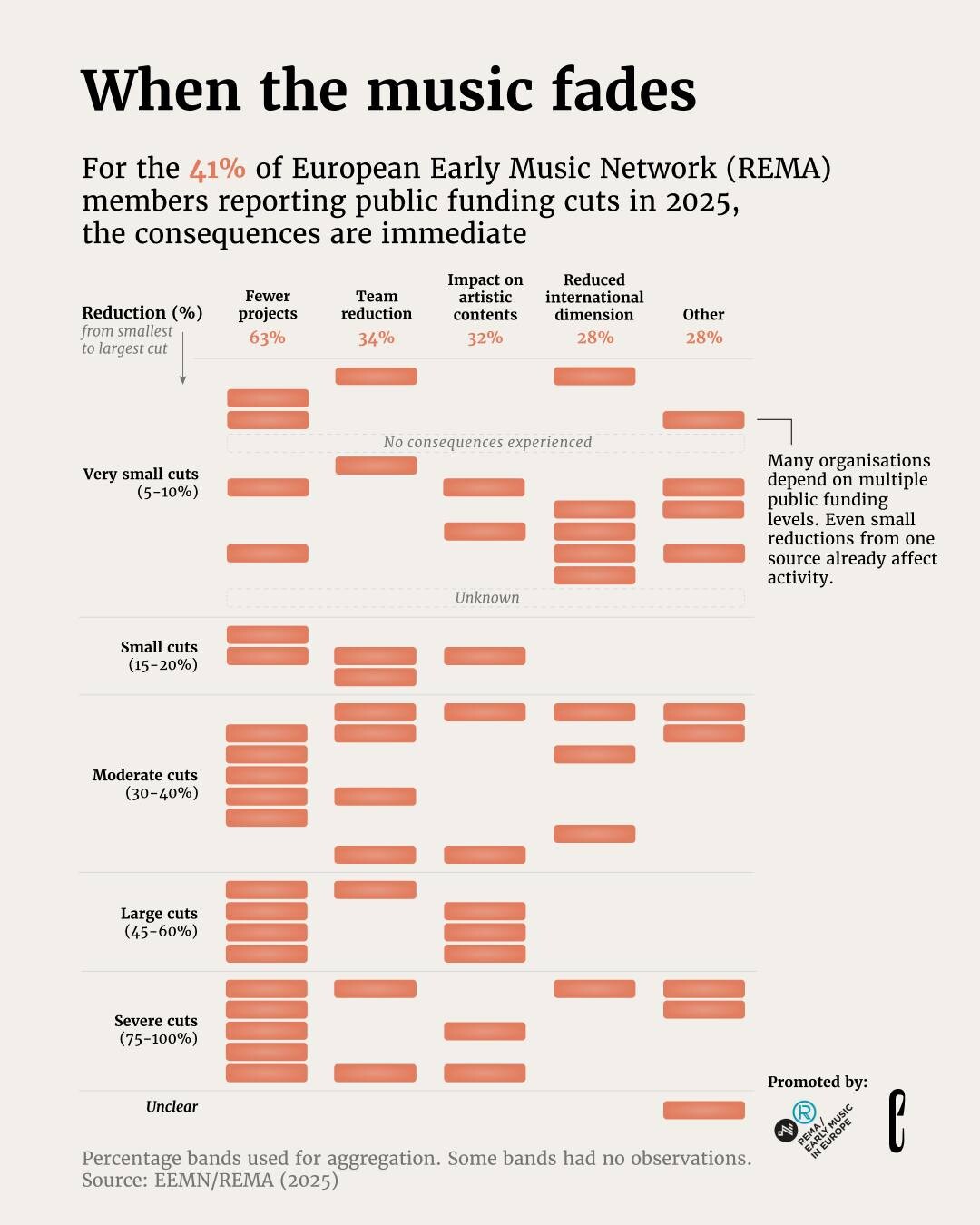
Among respondents — 80 organisations representing festivals, ensembles, research institutes, conservatories and labels across 29 countries — 41% reported experiencing reductions in funding. This group is considered broadly representative of the network’s membership. While the data reflects the situation within the European early music sector, further surveys would be necessary to extend the analysis to other areas of the cultural field.
Even modest reductions can have immediate consequences. A funding cut of just 5% by a region, a city, or the state may already result in fewer concerts for audiences, more cautious and less diverse programming choices, reduced opportunities for independent musicians, and increased pressure on organisations that are often already operating with limited margins.
The situation becomes even more challenging when several sources of funding are reduced simultaneously or disappear altogether.
As cultural funding systems vary widely across countries, assessing the severity of the situation on a national basis remains complex. In France, where structural public funding has traditionally been a cornerstone of support for independent ensembles and festivals, 57% of respondents reported cuts. In Italy, where public funding exists but tends to be less systematic, the figure was 28%. Because the survey was conducted at a specific moment in 2025 and did not take into account organisations’ resources over a longer period, the results should be understood as a snapshot in time. A follow-up in 2026 will help place these figures in a broader perspective.
The purpose of this analysis is not to question the European cultural model, which relies significantly on public subsidies. Whether cultural funding originates from public or private sources, however, reductions tend to produce similar consequences. The responses collected reveal that 41% of organisations experienced decreases in at least one funding stream, even though most rely on multiple sources of support — municipal, national, and in some cases international — which may be structural or project-based.
Even a single 5% decrease may lead to concrete adjustments: the cancellation of a concert or a reduced artistic team. A reduction of 10% can result in fewer outreach activities or the disappearance of free concerts. More significant cuts can have deeper structural effects, including reductions in administrative staff and an increasing imbalance between artistic activity and organisational workload. In a sector already under strain, such adjustments raise concerns about the sustainability of existing working conditions.
Even a single 5% decrease may lead to concrete adjustments: the cancellation of a concert or a reduced artistic team. A reduction of 10% can result in fewer outreach activities or the disappearance of free concerts. More significant cuts can have deeper structural effects, including reductions in administrative staff and an increasing imbalance between artistic activity and organisational workload. In a sector already under strain, such adjustments raise concerns about the sustainability of existing working conditions.
The cumulative effect of several reductions — whether repeated cuts of 5%, decreases of 10% or more, or the disappearance of specific project funding programmes — can be particularly severe. According to respondents, these cuts translate into salary reductions, job losses, fewer opportunities for independent musicians and, in some cases, the weakening of the international dimension that underpins the circulation of artists and repertoire within the European early music ecosystem.
In the longer term, the public ultimately bears the cost of these developments. Respondents report the disappearance of artistic director positions and a shift towards safer programming choices, reduced-scale projects without staging, or a stronger focus on established repertoire. Many organisations also report being unable to maintain less profitable activities such as outreach programmes that previously connected them with wider audiences.
As a result, the artistic offer available to the public risks becoming less diverse, less ambitious and ultimately less abundant. One key question therefore remains: are funding bodies fully aware of the consequences of reduced support for cultural organisations, or is the impact on cultural access an unintended effect of broader financial constraints? This question, however, opens a broader debate.
You might
like…

More

More

More