Laus Polyphoniae 2026
From 21 August to 29 August Belgium / Antwerp
Voices of Europe circa 1600, continent of counterpoint
In 1600, the European music scene is at a turning point.
The cusp of a new era marks a defining moment of change.
In 1600, the European music scene is at a turning point.
The cusp of a new era marks a defining moment of change.
That is how the story is often told. The story of a world where the pure, clear polyphony of Giovanni Pierluigi da Palestrina gives way to the dramatic gestures of Claudio Monteverdi, the Renaissance breathes its last, and the Baroque is born in a burst of triumph. However, the change will not strike attentive listeners as a sudden bolt of lightning from the blue, but more like a thousand tiny sparks: traditions and new sounds overlapping, divergent styles developing at the same time and composers experimenting without abandoning their predecessors. Works that would later be called Renaissance or Baroque existed in parallel and in tandem.
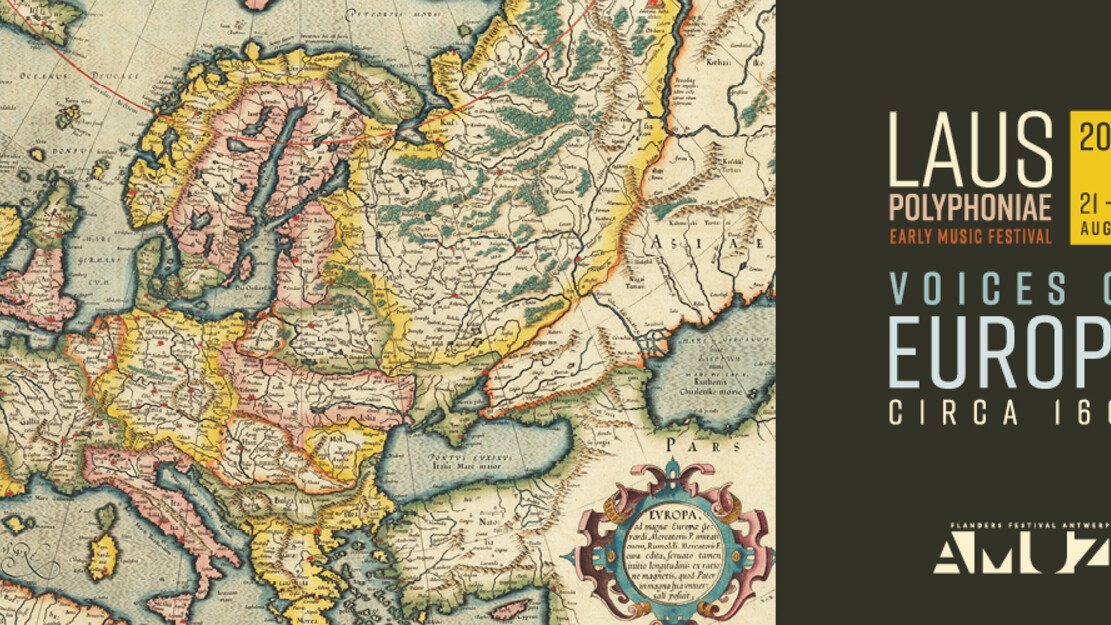
That is the essence of Laus Polyphoniae 2026: the portrait of a many-voiced Europe where music simultaneously reaches the full height of its powers and descends into decadence. Where Venice echoes in Prague, Seville resounds in Lisbon, Naples whispers to London and Munich is an undertone in the north and the south. Where music printing opens the floodgates of new ideas, where composers migrate, scores travel around the world, and ‘old’ and ‘new’ constantly spur each other on.
We find the polyphony of Iberian heroes like Tomás Luis da Victoria and Alonso Lobo still bathing in the afterglow of the High Renaissance as Orlandus Lassus is writing his Lagrime di San Pietro in Munich: a masterpiece that both looks back to the past and forward into the future. A wave of innovations from Italy complicates matters even further. Carlo Gesualdo hones the motet to perfection, Pomponio Nenna takes the art of the madrigal to its peak and Giovanni Gabrieli pushes polyphony to the threshold of a symphonic sound. This pioneering work does not fall on deaf ears: Hans Leo Hassler and Jacob Regnart create an original palette combining tints of Italian grandeur with Franco-Flemish counterpoint.
The revolutions in music are not restricted to western Europe: as the Venetian School tilts polychorality towards the Baroque and Portuguese polyphony goes global, Konstantinos of Aghialos and Joasaph of Mount Athos herald a Byzantine Renaissance in Greece. Around the year 1600, central Europe is an open intersection. Composers seek work and protection in Czechia, Moravia, Poland and Southern Germany; the manuscripts in circulation there combine local names such as Matthias Reymann and Wojciech Długoraj with English and French icons. It is as if the world were getting a little smaller. Or composers were seeing a bigger picture. The Oxford graduate Richard Dering settles in Brussels; his fellow Italophile Pierre Bonhomme moves to Liège, and Scandinavia gets a visit from John Dowland.
The revolutions in music are not restricted to western Europe: as the Venetian School tilts polychorality towards the Baroque and Portuguese polyphony goes global, Konstantinos of Aghialos and Joasaph of Mount Athos herald a Byzantine Renaissance in Greece. Around the year 1600, central Europe is an open intersection. Composers seek work and protection in Czechia, Moravia, Poland and Southern Germany; the manuscripts in circulation there combine local names such as Matthias Reymann and Wojciech Długoraj with English and French icons. It is as if the world were getting a little smaller. Or composers were seeing a bigger picture. The Oxford graduate Richard Dering settles in Brussels; his fellow Italophile Pierre Bonhomme moves to Liège, and Scandinavia gets a visit from John Dowland.
The footprints they leave in the music chronicles of the year 1600 are traced by Laus favourites Collegium Vocale Gent, Vox Luminis, Paul O’Dette, Stile Antico, Huelgas Ensemble, The Gesualdo Six and New York Polyphony, as well as festival newcomers Tenebrae, Ensemble Irini, Les Meslanges and Près de votre oreille. This impressive line-up will deliver exciting performances, surprisingly modern classics and big hits that are seldom heard live. And there’s more: a lecture on Europe, plus workshops and concert introductions to give the programme the depth you expect from Laus Polyphoniae.
Laus Polyphoniae 2026 promises to be a wonderland of voices and stories.
Open the door, choose a path and allow yourself to be astonished!
Open the door, choose a path and allow yourself to be astonished!