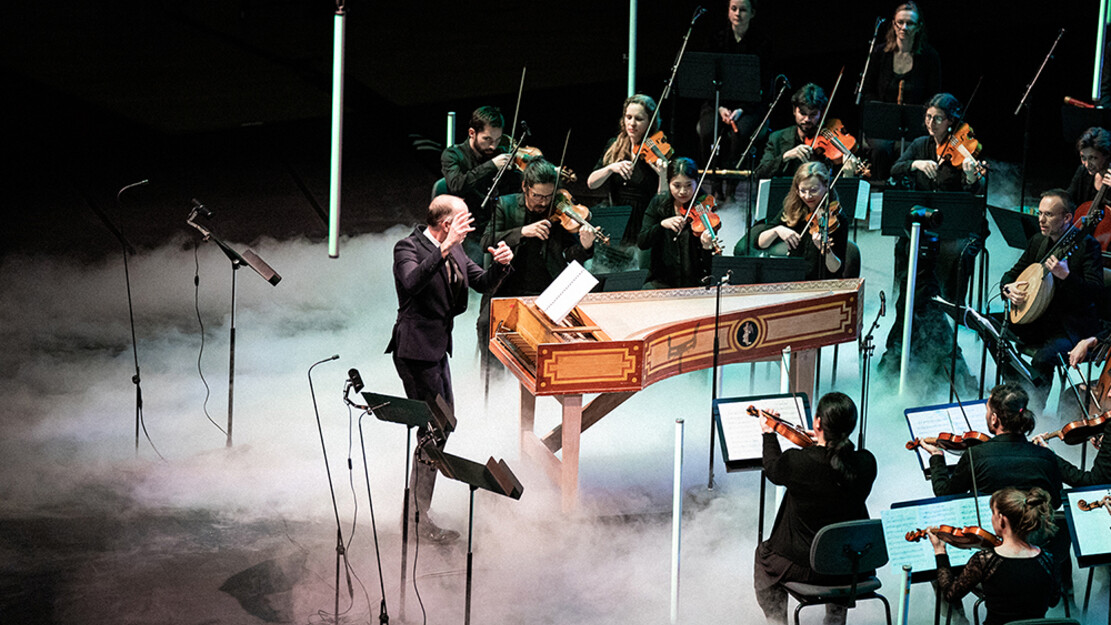
Dixit Dominus
03 June/20h00 France / Lyon
To approach Handel's Dixit Dominus is to affirm a profound conviction: the Baroque repertoire is not a static heritage, but a veritable theater of emotions, a sonic laboratory where music is experienced as a physical, dramatic, and sensory experience.
Composed in 1707, this dazzling work reveals a young and audacious Handel, steeped in Italian exuberance and already animated by an irresistible theatrical instinct. Dixit Dominus transcends the realm of sacred music to become a dramatic fresco, where biblical words are transformed into gesture, tension, movement, and light. This spectacular dimension is at the heart of our approach and illuminates the full modernity of a visionary Handel.
Composed in 1707, this dazzling work reveals a young and audacious Handel, steeped in Italian exuberance and already animated by an irresistible theatrical instinct. Dixit Dominus transcends the realm of sacred music to become a dramatic fresco, where biblical words are transformed into gesture, tension, movement, and light. This spectacular dimension is at the heart of our approach and illuminates the full modernity of a visionary Handel.
Composed the same year, Christ lag in Todesbanden testifies to the expressive power of the young Bach, already perceptible in his early cantatas. Alternating between monumental chorales, arias, and ensembles, the work combines vocal virtuosity with contrapuntal clarity. Echoing Dixit Dominus, it offers another vision of the afterlife: more internalized, traversed by shadows and light, where the divine presence becomes closer, almost human.
Between these two peaks, two rarer works weave luminous bridges: the motet Lobet den Herrn by the Cantor of Leipzig — presented here from a manuscript kept at the Lyon Municipal Library — and the delicate Salve Regina for solo soprano by the young Handel.
PROGRAMME
PROGRAMME
Johann Sebastian Bach, Cantata Christ lag in Todesbanden (BWV 4) and Motet Lobet den Herrn (BWV 230) in the BmL version; Georg Friedrich Handel, Salve Regina (HWV 241) and Dixit Dominus (HWV 232).
DISTRIBUTION
Spirito – Chamber Choir
Thibaut Louppe, choir preparation
Heather Newhouse, soprano
Magali Perol-Dumora, soprano
Léo Fernique, alto
Almeno Gonçalves, tenor
Imanol Iraola, baritone
Thibaut Louppe, choir preparation
Heather Newhouse, soprano
Magali Perol-Dumora, soprano
Léo Fernique, alto
Almeno Gonçalves, tenor
Imanol Iraola, baritone